
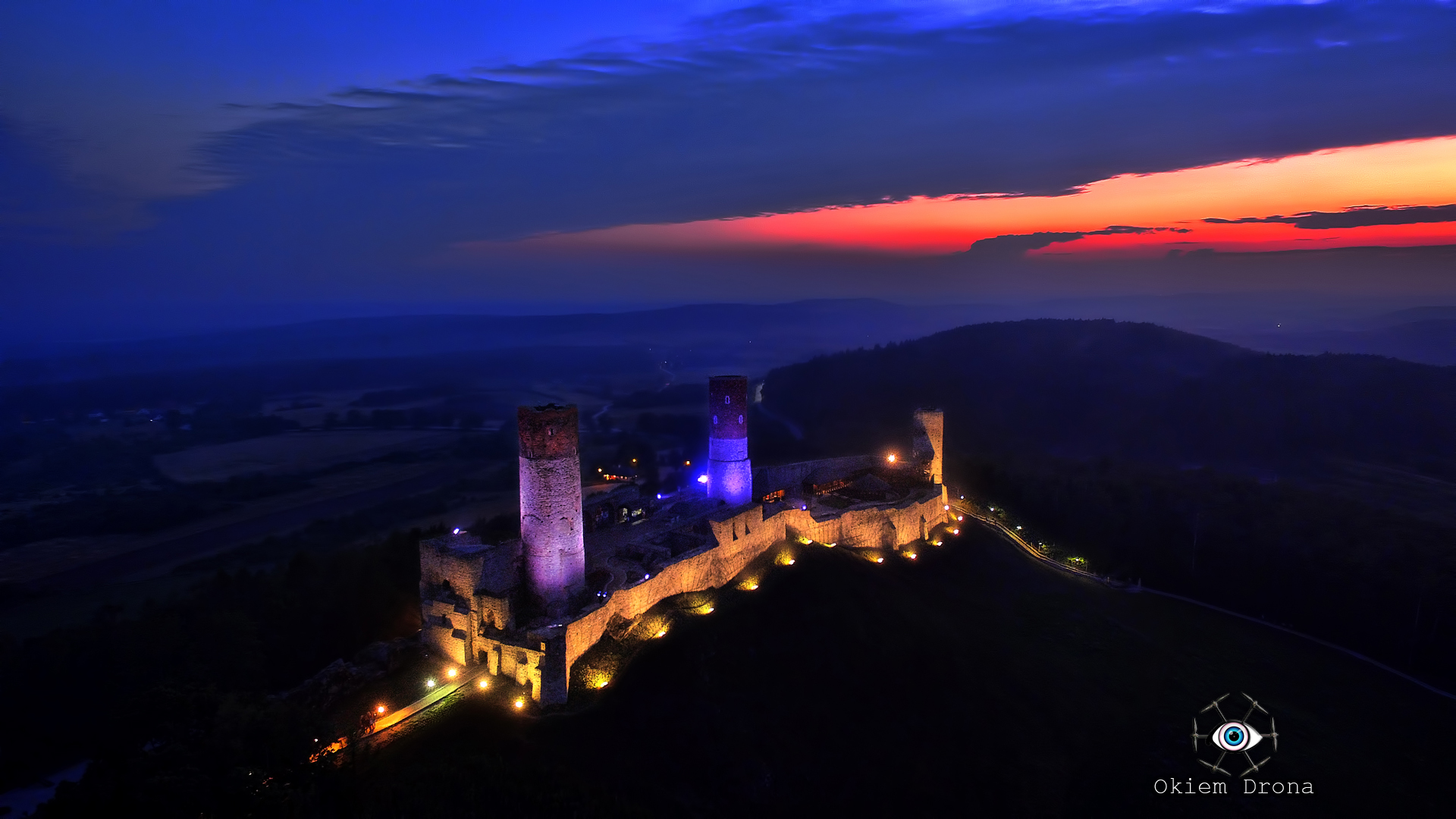
The construction of the fortress probably began around XIII/XIV century. Around this date the upper part of the castle, comprising of upper courtyard with housing unit and two rounded defensive towers was built. The castle had its own chapel, located by the eastern tower. The castle treasure was being kept in the room above the chapel. It is certain that the castle existed in 1306, when king Władysław Łokietek presented it to the Archbishop of Kraków, Jan Muskata. In following years a dispute on ownership title of then Lesser Poland has been raised between the king and the bishop. As a result of the dispute, after detection of a plot against the royal power, the castle was returned to the king. King Łokietek soon made the royal castle in Chęciny the centre of his political and military power. In 1318 the treasure of the Archdiocese of Gniezno was transferred and hidden inside the castle to prevent it from being captured by Teutonic Knights. The castle played a significant role as a place of concentration of Polish troops departing for Battle of Płowce with the Teutonic Knights in 1331. In the first half of the XIV century the stronghold was enlarged by King Casimir III the Great. Then the lower courtyard with a rectangle tower was constructed, forming the existing shape of the castle. At that time Chęciny became a residence of the king’s second wife Adelaide of Hesse. It was also a residence of Elisabeth of Poland, Queen of Hungary, Sophia of Halshany and her son Władysław III of Varna and Italian by origin – Polish Queen Bona Sforza, who departed Poland in 1556. Later it was used for many years as a state prison with main dungeon located underneath the eastern tower. Among imprisoned here were: Michael Küchmeister von Sternberg future Grand Master of the Teutonic Knights, Andrzej Wingold, King Jogaila’s half-brother. The castle briefly regained its former glory due to reconstruction initiated by Stanisław Branicki, Starost of Chęciny. However, in the second half of the 16th century, the castle began to decline. In 1588 the parliament ordered to transfer the castle’s inventories to the Chęciny Parish Church. In 1607 the Castle was captured and burned by the Zebrzydowski Rebellion. In 1657 the Castle was again partially destroyed by the Rakoczy troops. During the Swedish Deluge the Castle turned into a ruin and remains in that state to this day. The ruins of the Castle have been preserved several times. First major construction works were undertaken in 1877. Between First and Second World Wars the castle was preserved by then mayor of the city Edmund Padechowicz. After the Second World War the castle was again preserved and partially reconstructed with middle tower rebuilt. Since then the eastern tower serves as a scenic viewpoint.


